
The New Digital and Preventive Health Economy in Singapore – How Does It Benefit Clinics & Private Healthcare Practitioners?
By Medinex Team
Dec 19, 2025
By Medinex Team
Table of Contents
ToggleHave you heard of Healthier SG, Healthy 365 and HealthHub? As a healthcare service provider, you are likely to be aware that the former is the Singapore Government’s national preventive health initiative that aims to shift Singapore from a reactive, disease-based healthcare system to a proactive, preventive one. The latter two are apps developed by the government to encourage lifestyle modification and better health management.
The bottom line is that Singapore residents are encouraged to take ownership of their own health, and these efforts are part of the government’s initiatives to facilitate this move. As healthcare service providers, the pertinent question would be, “How can primary care providers be part of this larger Singapore healthcare ecosystem?” In this article, we will explore the business implications and benefits for healthcare service providers to align with this national healthcare movement.
1. The Healthier SG Pivot
This shift to preventive care creates opportunities for General Practitioners (GPs) to provide personalised health planning and long-term chronic disease management for enrolled citizens. Singapore is a “super-aged” society, and the demand for Aged Care and Chronic Disease Management will continue to rise over time.
For primary care and long-term care providers to be fully integrated into this ecosystem, they need to understand the changes in their roles with this pivot and adopt a new mindset. They must transition from episodic to longitudinal care and adopt a proactive approach to patient engagement, rather than being reactive.
Residents enrol with a chosen GP or polyclinic, making them the main point for care and guiding the patients through the system.
Doctors need to co-create customised plans, including annual check-ins and discuss health goals with the patients.
To promote screenings (cancer, chronic diseases), immunisations (adult & child), and lifestyle changes to prevent future illnesses or detect them early.
To manage conditions like diabetes, hypertension, and high cholesterol, with subsidised medications.
To link patients to specialists or community resources when needed, integrating health and social care.
2. Embracing the New Digital Health Economy
Besides the shift to preventive health, Singapore’s digital health economy is also rapidly expanding with a government-backed ecosystem that acts as a leading regional hub for HealthTech innovation. Let’s do a quick review of various applications and technologies to better understand the digital health landscape.

Telehealth and Telemedicine
The COVID-19 pandemic accelerated the adoption of virtual consultations and remote patient monitoring, moving these from fringe services to mainstream offerings. With the advancement in Wearable Technologies and IoT, devices such as smartwatches, continuous glucose monitors, and in-home sensors are widely adopted to provide real-time health insights and support continuous monitoring, shifting care from hospitals to homes.
In 2022, Changi General Hospital partnered Respiree, a local MedTech startup, to advance patient care through smart remote monitoring of vital signs.
Telehealth and Telemedicine
The COVID-19 pandemic accelerated the adoption of virtual consultations and remote patient monitoring, moving these from fringe services to mainstream offerings. With the advancement in Wearable Technologies and IoT, devices such as smartwatches, continuous glucose monitors, and in-home sensors are widely adopted to provide real-time health insights and support continuous monitoring, shifting care from hospitals to homes.
In 2022, Changi General Hospital partnered Respiree, a local MedTech startup, to advance patient care through smart remote monitoring of vital signs.
Artificial Intelligence (AI) and Data Analytics
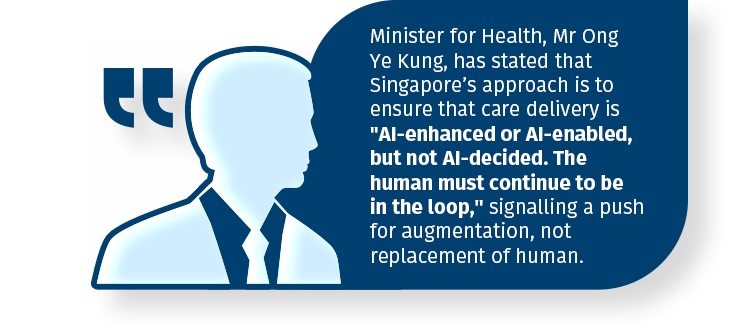
AI is a key focus area, used in applications for early disease detection, predicting hospital readmissions, and automating medical documentation.
The national healthtech agency, Synapxe, launched platforms like Synapxe Tandem that boast secure, healthcare-compliant GenAI tools that are now assisting doctors in automating documentation.

Artificial Intelligence (AI) and Data Analytics
AI is a key focus area, used in applications for early disease detection, predicting hospital readmissions, and automating medical documentation.
The national healthtech agency, Synapxe, launched platforms like Synapxe Tandem that boast secure, healthcare-compliant GenAI tools that are now assisting doctors in automating documentation.
For healthcare service providers, these major shifts to focus on preventive health and digital health technologies bring potential opportunities and competitive pressures. As such, whether you have been operating in Singapore for years or are planning to start a new healthcare business in Singapore, finding a partner who understands the local healthcare landscape is of paramount importance.
MEDINEX Limited is an established one-stop consultancy service with more than 20 years of experience in company incorporation, accounting & tax services, HR and business consultancy specialising in helping healthcare service providers. We understand the challenges and have the necessary expertise to provide the right solutions to overcome them. For further consultation, send us an email at contact@medinex.com.sg.

